Dalia Dédinskaité - violin & Gleb Pyšniak - cello • Lossimuusika
Sunday, December 7, 2025 at 6 p.m.
Kadriorg Palace / Kadriorg Art Museum, Tallinn
PALACE MUSIC
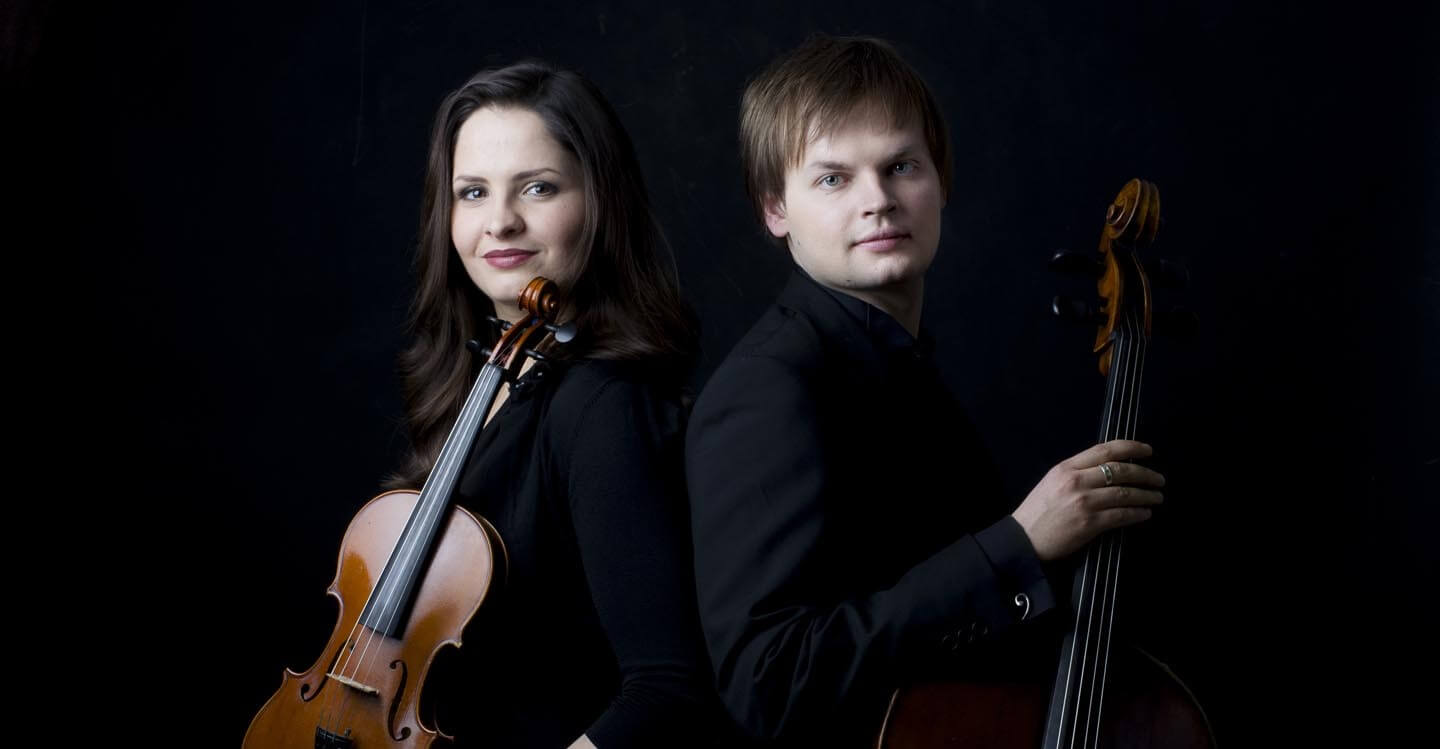
Duo Dalia Dedinskaite & Gleb Pyšniak (Lithuania)
Dalia Dedinskaite - violin
Gleb Pyšniak - cello
Program:
Anatolijus Šenderovas (1945-2019)
Dialogue II for violin and cello
Mikalojus Konstantinas Čiurlionis (1875-1911)
Piano preludes (arr. for violin and cello)
Maurice Ravel (1875-1937)
Sonata for violin and cello M.73
Allegro
Très vif
Lent
Vif, avec entrain
Pēteris Vasks (s. 1946)
"Castillo Interior" for violin and cello (2013)
Georg Friedrich Händel (1685-1759) - Johan Halvorsen (1864-1935)
Passacaglia in G minor for violin and cello (1894)
In cooperation with Lithuanian Embassy in Tallinn
Anatolijus Šenderovas' music has distinctly recognizable sound and does not lack magic for its specific modal colour, improvisational character, development of the piece from a single thematic motto, emotionality, strong dramatic expression and energy. His music includes elements of both archaic Oriental music and more abstract atonal style. The composer did not adhere to a single method of composition, instead he chose particular most appropriate composing techniques for every new piece. Anatolijus Šenderovas gave a lot of attention to the sacred themes, using the stories and texts from the Old and New Testament in Hebrew and Latin. His music perfectly fits in the European new music context and is often performed by the Lithuanian musicians as well as performers from the other continents.
The composer Mikalojus Konstantinas Čiurlionis was an outstanding symbolist artist whose musical ideas resonate in his imaginative visual art. Extraordinary talent and excellent, versatile education allowed him to perceive the world in an original way and to have a voice in the development of European avant-garde. During six very intense years (1903–1909) he created a total of 400 musical and 300 visual works.
Čiurlionis holds an exceptionally important role in Lithuanian culture and national consciousness. His work is not only deeply imbued with Lithuanian mythology and folklore, but he was also a patriot who dedicated all his creativity to his homeland.
The art critic Alexandre Benois called Čiurlionis "a genius cursed by fate, who creates transcendent works of indescribable meaning".
The Sonata for Violin and Cello is a composition written by Maurice Ravel from 1920 to 1922. He dedicated it to Claude Debussy, who had died in 1918. It premiered on 6 April 1922 with Hélène Jourdan-Morhange playing the violin and Maurice Maréchal the cello. It is in the key of A minor, with the fourth movement in the relative major key of C. It is M. 73 in the catalogue compiled by Marcel Marnat.
Latvian composer Pēteris Vasks about his work "Castillo Interjöör": "This piece for violin and cello was written in 2013 at the suggestion of Sol Gabetta. In early 2014, I spent some time meditating in a quiet and remote place by the Baltic Sea. There, the string duo finally got its title. As a tribute to the great mystic and Saint Teresa of Avila, I named the composition Castillo Interjöör. The meditative composition is interrupted twice by fast and energetic passages. It is a spiritual vertical, a path toward eternal light, and right beside it is today’s world – so diverse and full of contradictions."
Norwegian violinist and outstanding conductor Johan Halvorsen worked as a conductor at the Norwegian National Theater in Christiania for 30 years and composed numerous violin works in addition to orchestral music. In 1894 he made a sumptuous arrangement for violin and viola based on the Passacaglia from Handel's Harpsichord Suite in G minor. Havorsen put into play all possible and impossible ways of playing on the strings and with his extraordinary imagination created a brilliant masterpiece, the like of which is difficult to find in the entire string repertoire.
Born in Vilnius, Lithuania, Dalia Dedinskaite is one of the most prominent violinists of her generation in the Baltic States. After winning the prestigious International violin competition “Violine in Dresden 2010′′ in Germany, young artist was invited to perform the L. van Beethoven violin concerto in the festival “Dresdner Festspiele 2012 “. Since then violinist has performed as soloist and as chamber music artist in many European countries, the United States and New Zealand in many prestigious concert halls such as, among others, Vienna Musikverein, Elbphilharmonie Hamburg, The Juilliard School Paul Hall in New York, Chicago Cultural Center, Helsinki Musiikkitalo, Vatroslav Lisinski Hall in Zagreb, Odd Fellow Palæet Copenhagen, Lithuanian National Philharmonic Hall, Grand Salon des Invalides in Paris, the Great Guild of Riga City, Tel Aviv Museum of Art, Accademia Filarmonica Romana.
Dalia’s musical talent was noticed by her first teacher Elena Lašaitė, later Dalia studied with prof. Jurgis Dvarionas. The most prominent footprints in her musical career has left the studies with Austrian violinist, professor Christian Altenburger and chamber music lessons with professor Johannes Meissl at the Viennese University of Music, where Dalia earned her BA and MA cum laude with a distinction and the Rector’s Prize of Honour. Since 2016 Dalia has settled in Lithuania whilst is regularly visiting Austria, where she was appointed as assistant to Prof. Christian Altenburger at the University of Music and Performing Arts Vienna. From 2016 Dalia was the 1st Concertmaster of the Klaipėda Chamber Orchestra and in 2020 she became the Principal Concertmaster of the Lithuanian National Symphony Orchestra.
As a soloist, Dalia Dedinskaite has performed with the Lithuanian State Symphony Orchestra (Saulius Sondeckis), Lithuanian National Symphony Orchestra (Georg Mark, Juozas Domarkas), “Dresdner Kappelsolisten” (Helmuth Branny), Symphony Orchestra of the Dresden Carl Maria von Weber Academy of Music (John Holloway), Klaipėda Chamber Orchestra, Camerata Ars Lituanica, Estonian chamber orchestra ME103 (Andris Veismanis), Vilnius chamber choir “Jauna Muzika” (Vaclovas Augustinas).
Beside solo activities, the violinist is an enthusiastic chamber music artist – Dalia has performed at many international chamber music festivals, such as “The 10th Annual Chamber Fest” in New York, “Schwäbischer Frühling” in Germany, “The International Holland Music Sessions”, “Loisiarte”, “Attergauer Kultursommer”, “Festival St. Gallen” and“ International Rattenberg Festival ” in Austria, “Grieg in Bergen” and “International Bergen Festival” in Norway, “Nafplion Festival” in Greece, “Fundación Monteleon” in Spain, etc., where she shared the scene with musicians like Christian Altenburger, Franz Bartolomey, Patrick Demenga, Lukas Geniušas, Josef Gilgenreiner, Pavel Giunter, Ole Christian Haagenrud, Cornelia Hermann, Reinhard Latzko, Christoph Schiller, Thomas Selditz, Mihaela Ursuleasa, Quirine Viersen.
Contemporary music and collaboration with contemporary composers plays a very important role in the violinist’s life. In 2014 she performed début recitals together with the cellist Gleb Pyšniak the world Lithuanian première of “Duettissimo” by Vytautas Barkauskas at the Musikverein Hall in Vienna. The composer dedicated the work to the duo of Dalia and Gleb. In the same year together with Vilos Trio, ordered by Austrian publishing company “Capriccio”, Dalia recorded complete piano Trios by Austrian contemporary composer Johanna Doderer. Compact disc was published in Vienna and presented at the Austrian National Library filming on the ORF (Austrian National Television). “…A stunning record. Necessary to listen. “- Wiener Zeitung about the début CD of the Vilos Trio. (10/14/2014)
Starting in 2015, Dalia, along with cellist Gleb Pyšniak, took the lead in various projects important for Lithuanian musical and cultural life – National Forum “Ars Lituanica”, Youth Education Project “Artistico”, whose main purpose is to support Lithuanian young talents of classical music. An especially successful project of Lithuanian music initiated by Dalia and Gleb “Window to Lithuania” – a CD with more than a hundred years of Lithuanian music history collection of jewels. The album was presented to listeners in more than a dozen European countries and the US, this way it commemorates the 25th anniversary of independence restoration of the Republic of Lithuania. The concert was filmed and recorded by LRT (Lithuanian National Radio and Television) in Vilnius. Not less attention received from “Aerogram“ another compact disc project of the Litvak (Lithuanian Jewish origin) composers’ music, featuring composers such as A. Copland, G. Gershwin, B. Goodman, J. Achron, L. Godovsky. During album presentations in Europe and US Litvak culture is represented as an important part of Lithuanian culture. Concert in Vilnius was recorded by LRT (Lithuanian National Radio and Television).
Dalia is the winner of many international and national competitions: “Violine in Dresden 2010” in Germany, “International IV Alexander Glazunov” in Paris, Balio Dvariono Competition for Pianists and Strings, Raimundas Katilius Violin competition, The 6th International Stasys Vainiūnas chamber music competition and others. In the year 2012 during the festival-masterclass “ISA Prague-Vienna-Budapest” together with cellist Gleb Pyšniak, Dalia was awarded “Kodály Award” for Outstanding Zoltán Kodály Duo op.7 for violin and cello performance.
Dalia attended master classes with Shmuel Ashkenasi, Ivry Gitlis, Natalia Gutman, Maria Kliegel, Tuls Mørk, Miklós Perényi, Dmitry Sitkovetsky, Richard Stoltzman and other. For her invaluable music and life lessons and overall support, Dalia is grateful to Mr. Ernst Haupt- Stummer.
Dalia Dedinskaite together with her husband Gleb Pyšniak, also known as violin and cello ensemble “Duettissimo”, are artistic directors of Kintai Music Festival and co-founders of Joseph Achron Music Festival and “Christmas in Vilnius” (“Kalėdinis Vilnius”) Festival in Lithuania.
Gleb Pyšniak, one of the most prominent cellists of his generation in the Baltic States. Born in 1987 in Vilnius, the young cellist as early as at the age of 14, made his debut as a soloist with the Lithuanian Chamber Orchestra (conductor Professor Saulius Sondeckis) on the stage of the Lithuanian National Philharmonic Society. And now, throughout his career, the artist has performed as a soloist and chamber music artist in many prestigious concert halls such as, among others, the Royal Concertgebouw of Amsterdam, Vienna Musikverein, the Great Hall of Moscow Conservatory, Rome Quirinal Palace, Accademia Filarmonica Romana, Helsinki Musiikkitalo, Casa da Musica of Porto, Vatroslav Lisinski Concert in Zagreb, Grand Salon des Invalides in Paris, Hofburg Palace in Vienna, Teatro Verdi in Pisa, the Great Guild of Riga City, Tel Aviv Museum of Art, the Paul Recital Hall of Julliard School in New York, Chicago Cultural Centre.
In 1998, Gleb Pyšniak entered the Balys Dvarionas Music School (Vilnius, Lithuania) where he studied in the cello class of teaching expert Tatjana Kuc. Gleb Pyšniak continued his studies at the Lithuanian Academy of Music and Theatre with Professor Rimantas Armonas and here he obtained his bachelor’s degree. In 2015, the aspiring musician earned an MA cum laude from the Vienna Conservatory in the cello class of Professor Natalia Gutman and a BA cum laude from the University of Music and Performing Arts Vienna in the chamber music class of Johannes Meissl. During the studies Gleb Pyšniak was enriched by the master classes with Yo-Yo Ma, Mstislav Rostropovich, Ivry Gitlis, Heinrich Schiff, David Geringas, Tuls Mørk, Philippe Muller, Lluis Claret, Dmitri Ferschtman, Michael Flaksman, Johannes Goritzki, Maria Kliegel, Reinhard Latzko, Monika Leskovar, László Mezö, Miklós Perényi, Jérôme Pernoo, Jeroen Reuling, Gustav Rivinius, Silvija Sondeckienė and others.
Since 2019 Gleb Pyšniak joined the teaching team of the Lithuanian Academy of Music and Theatre.
As a soloist, cellist Gleb Pyšniak has performed together with, among others, the Lithuanian National Symphony Orchestra (conducted by Georg Mark, Modestas Pitrenas), the Lithuanian State Symphony Orchestra (conducted by prof. Saulius Sondeckis), the Symphony Orchestra of Porto (conducted by Alexandr Shelley), the Symphony Orchestra of Kaunas (conducted by Modestas Pitrenas), the Moscow Conservatory Symphony Orchestra (conducted by Andris Vecumnieks), the Lithuanian Chamber Orchestra (conducted by Saulius Sondeckis and Martynas Stakionis), Sinfonietta Riga (conducted by Normunds Šne), St. Christopher Chamber Orchestra (conducted by prof. Donatas Katkus, Giedrė Šlekytė, Modestas Barkauskas), Vidzeme Chamber Orchestra (conducted by Andris Veismanis), Klaipeda Chamber Orchestra, Camerata Ars Lituanica. The artist has given solo and chamber music concerts in many European countries, China, and the USA.
Gleb Pyšniak is a prize-winner of many national and international competitions including the Karl Davydov IV International Cello Competition; the 1st prize as well as a special prize Accord case winner of the VI Antonio Janigro International Cello Competition in Poreč , the 1st prize as well as a special prize of the August Dombrovskis VI International Competition, the 1st prize in the competition of string instruments of all Lithuanian academies in 2008, Grand Prix in the competition organized by the society of Jews in Lithuania in 2008, Yamaha Award winner in 2010, and in addition to winning many others.
In 2005 Mr. Pyšniak was awarded a grant of the Monsignor Kazimieras Vasiliauskas Fund. In 2006, Gleb Pyšniak received an award by Valdas Adamkus, President of the Republic of Lithuania for the glorification of the name of Lithuania, and in 2020, he was awarded by President of the Republic of Lithuania Gitanas Nausėda.
At the International Holland Music Sessions 2009, Gleb Pyšniak was selected the New Master on Tour and was offered a chance to perform in the world’s most distinguished concert halls.
Among concert activities Mr. Pyšniak together with his wife violinist Dalia Dėdinskaitė, violin and cello duo known as "Duettissimo", is artistic director of Kintai Music Festival, Joseph Achron Music Festival and "Christmas in Vilnius" (“Kalėdinis Vilnius”) Festival.
Kadriorg Palace is one the most well known and beautiful historic concert halls in Estonia offering memorable music experiences already for many decades. The tradition of performing music in the baroque palace goes back to 18th century when court music accompanied the daily life. The palace has had the pleasure to welcome many international artists and ensembles for outstanding performances.
The construction of the Kadriorg Palace was started by the Tsar Peter the Great of Russia in 1718. It was named Catharinenthal (in Estonian Kadriorg) in honour of his wife Catherine I. The palace was designed by the Italian architect Nicola Michetti and its abundantly decorated main hall is one of the most exquisite examples of baroque architecture both in Estonia and in northern Europe.
Kadriorg Palace has always been the crown jewel of Tallinn. The small festive tsars’ palace in the style of Roman Baroque, surrounded by a regular garden, with fountains, hedges and flowerbeds, planned after the model of Versailles.
The palace was a summer residence of Russian emperors untill 1917. In the 1920s, and again in 1946-1991 palace served as the main building of the Art Museum of Estonia. In the 1930s, it was the residence of the Head of State of the Estonian Republic. In 2000, it was opened as the Kadriorg Art Museum, which displays the largest collection of old Russian and Western European art in Estonia.
Music has been performed in the palace halls since the 18th century. In the past few decades, the most brilliant Estonian and international musicians have delighted listeners in the palace. Regular concerts started to take place in the Kadriorg Palace again in 2014, when the museum launched the Palace Music Concert Series. The extraordinary acoustics and the magnificent interior of the main hall make every concert a truly enjoyable artistic experience.
The artistic director of the Palace Music Concert Series is Aare Tammesalu.
In cooperation of the Art Museum of Estonia.
Tickets are on sale at the Kadriorg Art Museum and Piletikeskus outlets.
Supporters: Estonian Ministry of Culture, The Cultural Endowment of Estonia, Estonian Public Broadcasting, Tallinn Culture and Sports Department, UNESCO City of Music Tallinn, Kultuurikõla, Pointprint
Special thanks: Visit Estonia, Visit Tallinn, Õhtuleht
Event timeline/line-up