Éric-Maria Couturier • Lossimuusika
Sunday, February 8, 2026 at 6 p.m.
Kadriorg Palace / Kadriorg Art Museum
PALACE MUSIC
SEVEN PRELUDES
Éric-Maria Couturier - tšello
The Seven Preludes, based on the Cello Suites of J. S. Bach, are inspired by the Sainte-Baume cave, which legend says sheltered Saint Mary Magdalene, who was carried seven times a day by angels to the mountaintop. Alternating with Bach's six preludes, improvisations offer a seventh prelude and a feeling of elevation shared by all.
Johann Sebastian Bach (1685–1750) was known in his lifetime primarily as an organist, harpsichordist, and improviser. However, his musical career began in 1703 in Weimar as a violinist. A few years later, he became the leader of the Weimar court orchestra, and later the Kapellmeister at the Köthen court. Bach’s violinist career was crowned in 1720 with the completion of the work titled “Sei solo a Violino senza Basso accompagnato” (“Six Sonatas and Partitas for Solo Violin”). The manuscript contains performance markings in the composer’s own hand, indicating that he was capable of performing this highly complex music himself. Around the same period, he composed another similar work—the “Six Suites for Solo Cello”. The original score has been lost over time, but the music survived thanks to manuscript copies.
The cello suites fell into oblivion for more than a century. After their “rediscovery” in 1825, they were indeed printed, but aroused little interest and were mainly used as technical exercises. In 1889, a 13-year-old ambitious cellist, Pablo Casals, happened upon a worn copy of the cello suites in a second-hand music shop. While studying them at home, he quickly realized their true significance. Casals became a passionate devotee and fervent advocate of Bach’s cello suites. His 1936 recording had an explosive impact, and soon every self-respecting cellist on the planet felt the need to present their own interpretation of the suites—both on the concert stage and in recordings.
It seems almost unbelievable that nearly two hundred years were needed for Bach’s cello suites to be truly discovered and understood. Equally remarkable is the vitality and influence of this music: to this day, composers draw inspiration from Bach’s example when creating solo works, and cellists continue to find new interpretive perspectives. In 1979, Dutch cellist Anner Bylsma recorded the suites on a baroque cello, causing a sensation in the music world and profoundly changing the direction of the works’ interpretation. Among today’s leading cellists, Yo-Yo Ma successfully linked the suites with other forms of fine art in a series of television films in 1997.
There are over a hundred different editions of Bach’s Suites for Solo Cello, and they have been arranged for violin, viola, double bass, mandolin, piano, marimba, guitar, recorder, electric bass, French horn, saxophone, clarinet, bassoon, trumpet, tuba, ukulele, and many other instruments.
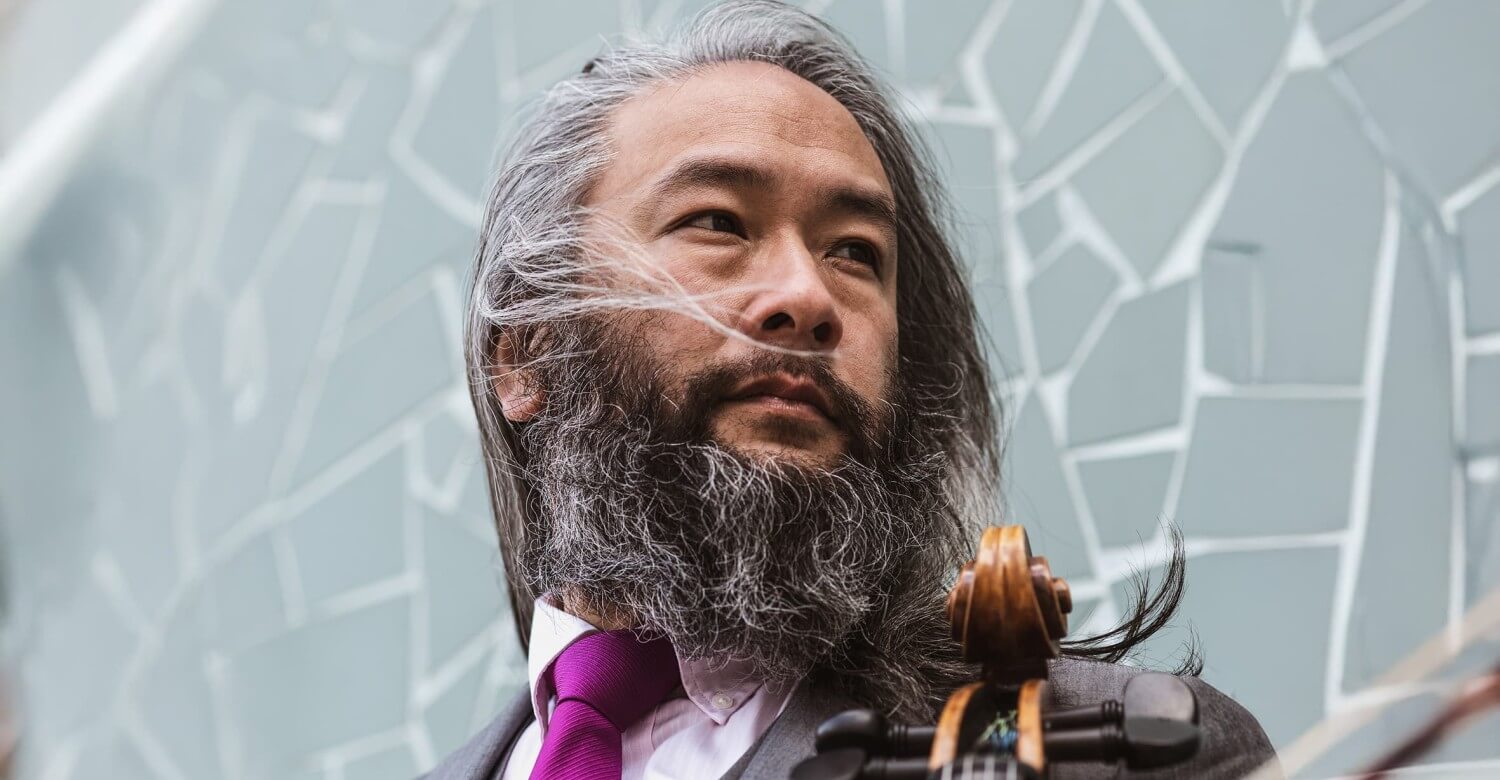
Éric-Maria Couturier is a professor at the Conservatoires Nationaux Supérieurs de Musique et de Danse of Paris and of Lyon. He has received teaching from Roland Pidoux, Christian Ivaldi, Igor Gavrich, Patrick Moutal, Jorge Chaminé, and is a great admirer of Mstislav Rostropovics and Yoyo Ma.
Polymorphous and virtuoso, he regularly performs on the major international stages, as a soloist, or in chamber music with the Talweg trio, with other artists such as Mauricio Pollini, Martha Argerich and Juliana Steinbach, and with the Ensemble intercontemporain, which he joined in 2002. With composer Olivier Derivière, he created the music for the video game Plague Innocent Tale / Requiem, as well as other games’ like Dying Light and Vampyre.
He has improvised in concert with David Linx, Laika and the Unit, Sébastien Lanson, and the electronics of the Plug trio with Michele Rabbia and Nicolas Crosse. With Bertrand Chavarria, he created a piece illustrating the energy of karate. He performs In Japan and in Europe with singer Noh Ryoko Aoki and percussionist Tsuchitori Toshi, a collaborator of Peter Brook.
Éric-Maria Couturier has worked with the greatest conductors, including Pierre Boulez, Wolfgang Sawallisch, Georg Solti, Carlo-Maria Giulini, Peter Eötvös, Susanna Mälkki, Jonathan Nott and Esa-Pekka Salonen, among others. He appears as soloist in the cello concertos of Haydn, Dvořák, Brahms double, Shostakovich, Eötvös, Fujikura, Kurtág, Merlin, Pfitzner, Saariaho and Robin, whose Quarks concerto is dedicated to him.
Fascinated by teaching based on improvisation, as well as the discovery of new techniques, Eric-Maria Couturier created Les Ateliers du violoncelle with Noémie Boutin and Vincent Courtois, with whom he regularly performs.
He plays with the bows of Claudia Carmona and Jean Grumberger.
Kadriorg Palace is one the most well known and beautiful historic concert halls in Estonia offering memorable music experiences already for many decades. The tradition of performing music in the baroque palace goes back to 18th century when court music accompanied the daily life. The palace has had the pleasure to welcome many international artists and ensembles for outstanding performances.
The construction of the Kadriorg Palace was started by the Tsar Peter the Great of Russia in 1718. It was named Catharinenthal (in Estonian Kadriorg) in honour of his wife Catherine I. The palace was designed by the Italian architect Nicola Michetti and its abundantly decorated main hall is one of the most exquisite examples of baroque architecture both in Estonia and in northern Europe.
Kadriorg Palace has always been the crown jewel of Tallinn. The small festive tsars’ palace in the style of Roman Baroque, surrounded by a regular garden, with fountains, hedges and flowerbeds, planned after the model of Versailles.
The palace was a summer residence of Russian emperors untill 1917. In the 1920s, and again in 1946-1991 palace served as the main building of the Art Museum of Estonia. In the 1930s, it was the residence of the Head of State of the Estonian Republic. In 2000, it was opened as the Kadriorg Art Museum, which displays the largest collection of old Russian and Western European art in Estonia.
Music has been performed in the palace halls since the 18th century. In the past few decades, the most brilliant Estonian and international musicians have delighted listeners in the palace. Regular concerts started to take place in the Kadriorg Palace again in 2014, when the museum launched the Palace Music Concert Series. The extraordinary acoustics and the magnificent interior of the main hall make every concert a truly enjoyable artistic experience.
The artistic director of the Palace Music Concert Series is Aare Tammesalu.
In cooperation of the Art Museum of Estonia.
Tickets are on sale at the Kadriorg Art Museum and Piletikeskus outlets.
Supporters: Estonian Ministry of Culture, The Cultural Endowment of Estonia, Estonian Public Broadcasting, Tallinn Culture and Sports Department, UNESCO City of Music Tallinn, Kultuurikõla, Pointprint
Special thanks: Visit Estonia, Visit Tallinn, Õhtuleht
Concert tickets are not refundable, but if necessary, we can exchange them for passes to other Palace Music concerts
Event timeline/line-up

Related
 Last 22 tickets