Palace Music: DUO ANDERSSON
Sunday, September 27, 2026 at 6 p.m. Kadriorg Palace / Kadriorg Art Museum
PALACE MUSIC
“Between Light and Shadow”
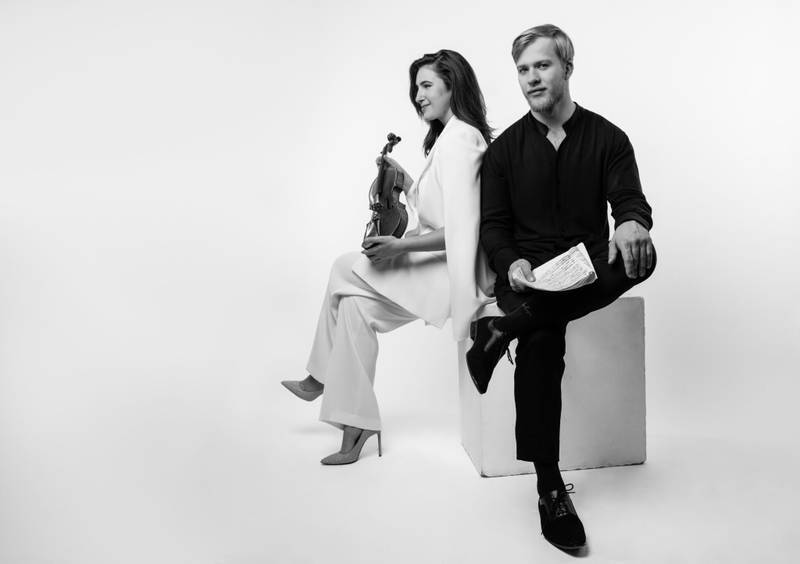
Duo Andersson
Julija Andersson - violin
Paulius Andersson - piano
Program:
Ludwig van Beethoven (1770–1827)
Sonata for Piano and Violin No. 4, Op. 23 in A minor
Presto
Andante scherzoso, più allegretto
Allegro molto
Faustas Latėnas (1956–2020)
Sonata for Violin and Piano
Moderato
Lento
César Franck (1822-1890)
Sonata for violin and piano in A major
Allegretto ben moderato
Allegro
Ben moderato: Recitativo-Fantasia
Allegretto poco mosso
In cooperation with Lithuanian Embassy in Tallinn and agency Uus Kontsert
Across centuries, the violin sonata has served as a space for composers to explore both intimacy and intensity — a dialogue where lyricism meets restlessness, and brilliance gives way to introspection.
Ludwig van Beethoven's extensive oeuvre comprises nine symphonies, five piano concertos, the Violin Concerto and the Triple Concerto for violin, cello and piano, 32 piano sonatas, sonatas for violin and cello, major sacred works, the opera Fidelio, a wealth of chamber and piano music, and more than a hundred songs. Many of the works are dominated by a heroic, pathos-filled mood, yet we also hear a virile lyricism. In form, he follows the classical traditions. His symphonies are characterised by powerful dynamic contrasts, extensive developments and enlarged orchestral forces.
Beethoven broke the boundaries of music and opened the way to Romanticism. His creative output changed dramatically, for he lived in an era when the French Revolution (1789–1799) shook Europe, bringing with it the ideals of liberty, equality and fraternity. Beethoven's early works followed the classical style of Haydn and Mozart, but the spirit of the French Revolution inspired him towards rebellious self-expression. His Third Symphony (1804) originally bore a dedication to Napoleon as the embodiment of the revolution, but later — disillusioned by his idol's dictatorial ambitions — he replaced it with the title Eroica ("Heroic"). Music born at the turning points of history became a symbol of humanism and resistance.
Beethoven's ten violin sonatas (opp. 12–96), together with the works of Mozart and Brahms, form the core of the violin repertoire, each sonata representing a distinct period in the composer's creative life. The best known of them is the "Kreutzer" Sonata in A major, Op. 47, completed in 1802, which was revolutionary for its time both in its technical demands and its emotional scope. The earlier op. 12 sonatas still follow Mozartian models, with the piano in the leading role, but from Op. 30 onwards the violinist becomes an increasingly important partner. In the late sonatas we hear a deeply felt dialogue between two equal and independent instruments.
Faustas Latėnas was a Lithuanian composer, theatre director and cultural figure, regarded as one of the most outstanding composers of his generation (the so-called neo-romantics). He studied composition at the Juozas Gruodis Conservatoire in Kaunas under Giedrius Kuprevičius, and subsequently at the Lithuanian Academy of Music and Theatre in Vilnius under Prof. Eduardas Balsys, graduating in 1980. Stage music constitutes the largest part of his output: he wrote music for more than 200 drama and puppet-theatre productions, as well as for nine feature films and 20 documentaries. He was closely associated with the director Eimuntas Nekrošius, and the music he created for Nekrošius's productions (including Hamlet and Faust) brought Latėnas onto the international stage. From 2002 onwards he also composed music for productions at the Vakhtangov Theatre in Moscow, enjoying a remarkably international career. For years Latėnas directed the Lėlė Puppet Theatre in Vilnius and the Lithuanian National Drama Theatre, and also served as Vice-Minister at the Ministry of Culture and as cultural attaché at the Lithuanian Embassy in Moscow. Among his concert works, the Agnus Dei for choir, organ and orchestra and his cello and violin sonatas are the best known; they have been recorded by, among others, David Geringas. He described his style, half-ironically, as "post-socialist realism", in which joy, sorrow and sarcasm are intertwined — in a word, a "merry-sad oeuvre", which during a life that ended suddenly in 2020 at the age of 64 earned him the Lithuanian National Prize for Culture and Arts.
Bridging past and present, the Violin Sonata by Faustas Latėnas inhabits a more fragile landscape. Its textures and gestures seem suspended between memory and immediacy, light and shadow — echoing tradition while speaking in a distinctly modern voice. Together, these works trace a path through contrast and continuity, revealing how the violin and piano, in dialogue, illuminate both brilliance and depth.
The Sonata for violin and piano in A major, composed by César Franck in 1886, is one of the composer's best-known works — and, at the same time, one of the most beloved violin sonatas of all time. Beyond its fascinating harmonic language, the work captivates through its monothematic construction and, above all, its extraordinary emotional tension. The 63-year-old composer's work became a wedding gift for the 31-year-old master violinist Eugène Ysaÿe, who, without a moment's hesitation, "unwrapped" it and, after a whirlwind rehearsal, performed it that very evening for the wedding guests. The official premiere took place on 16 December 1886 at the Musée d'Art Moderne in Brussels. The sonata quickly became a staple of Ysaÿe's concert repertoire, and over the following forty years he performed it with many distinguished pianists, including Théo Ysaÿe, Ernest Chausson, Ferruccio Busoni, Vincent d'Indy, Raoul Pugno, Camille Decreus, Arthur De Greef, Leopold Godowsky and Yves Nat. Although the numerous performances helped convince a broad public of the exceptional qualities of Franck's music, the deserved recognition came too late for the composer himself. The violin sonata became Franck's "musical monument".
“Duo Andersson is characterized not by the pursuit of outward effects, but by a deep exploration of thought, meaning, and subtlety — into that sphere where, according to Heinrich G. Neuhaus, that miraculous ‘almost-almost’ begins…” Daiva Tamošaitytė, Muzikos barai
Duo Andersson was founded in 2021 by two prominent young-generation Lithuanian musicians – violinist Julija Andersson and pianist Paulius Andersson. The duo are First Prize winners and recipients of the Special Prize for the best performance of J. Brahms at one of Europe’s largest chamber music competitions, the International Chamber Music Competition “Pinerolo” (2025, Italy). Actively promoting Lithuanian music abroad, the duo seeks to present rarely performed works and conceptually curated programs to international audiences. Duo Andersson have refined their artistry with legendary internationally acclaimed musicians, including Alfred Brendel, Kim Kashkashian, Krzysztof Węgrzyn, and others. In recent years, the duo has performed in Lithuania, Poland, the Netherlands, Germany, Spain, and Italy. In 2026, they will make their debut as soloists with the Lithuanian National Symphony Orchestra, performing the Lithuanian premiere of Bohuslav Martinů’s Concerto for Violin and Piano.
Kadriorg Palace is one the most well known and beautiful historic concert halls in Estonia offering memorable music experiences already for many decades. The tradition of performing music in the baroque palace goes back to 18th century when court music accompanied the daily life. The palace has had the pleasure to welcome many international artists and ensembles for outstanding performances.
The construction of the Kadriorg Palace was started by the Tsar Peter the Great of Russia in 1718. It was named Catharinenthal (in Estonian Kadriorg) in honour of his wife Catherine I. The palace was designed by the Italian architect Nicola Michetti and its abundantly decorated main hall is one of the most exquisite examples of baroque architecture both in Estonia and in northern Europe.
Kadriorg Palace has always been the crown jewel of Tallinn. The small festive tsars’ palace in the style of Roman Baroque, surrounded by a regular garden, with fountains, hedges and flowerbeds, planned after the model of Versailles.
The palace was a summer residence of Russian emperors untill 1917. In the 1920s, and again in 1946-1991 palace served as the main building of the Art Museum of Estonia. In the 1930s, it was the residence of the Head of State of the Estonian Republic. In 2000, it was opened as the Kadriorg Art Museum, which displays the largest collection of old Russian and Western European art in Estonia.
Music has been performed in the palace halls since the 18th century. In the past few decades, the most brilliant Estonian and international musicians have delighted listeners in the palace. Regular concerts started to take place in the Kadriorg Palace again in 2014, when the museum launched the Palace Music Concert Series. The extraordinary acoustics and the magnificent interior of the main hall make every concert a truly enjoyable artistic experience.
The artistic director of the Palace Music Concert Series is Aare Tammesalu.
In cooperation of the Art Museum of Estonia.
Tickets are on sale at the Kadriorg Art Museum and Piletikeskus outlets.
Supporters: Estonian Ministry of Culture, The Cultural Endowment of Estonia, Estonian Public Broadcasting, Tallinn Culture and Sports Department, UNESCO City of Music Tallinn, Kultuurikõla, Pointprint
Special thanks: Visit Estonia, Visit Tallinn, Õhtuleht
Concert tickets are not refundable, but if necessary, we can exchange them for passes to other Palace Music concerts
Schedule